
Actualités locales
China reaffirms peaceful development amid heightened global volatility


BEIJING, March 9 (Xinhua) — China’s annual « two sessions » have drawn elevated global attention this year, as lawmakers prepare not only to set the agenda for the coming year but also to approve a plan that could shape the country’s trajectory through the end of the decade.
The meetings of China’s top legislature and top political advisory body convene against a backdrop of deepening global turbulence. As geopolitical rivalries increasingly flout established rules and conflicts escalate in the Middle East, the international order faces unprecedented strain.
Policy choices of China — the world’s second-largest economy and home to 1.4 billion people — reverberate far beyond its borders. The direction set at this year’s « two sessions » will therefore be closely watched, particularly as many look to China for signals of stability in an increasingly uncertain world.
Currently under legislative review, the draft 15th Five-Year Plan maps out how China will advance over the next five years toward the goal of basically achieving modernization by 2035. A distinctive feature of this modernization is its emphasis on peaceful development.
In the next five years, China is expected to work with neighbors to advance integrated development and maintain overall stability in its relations with major nations, according to the draft plan.
At a press conference on China’s foreign policy held on the sidelines of the legislative session, Foreign Minister Wang Yi reaffirmed that China will not pursue hegemony as its strength grows, nor does it subscribe to the logic that the world can be run by major countries.
Analysts say that China’s preference for peace stems in part from a deep-seated cultural and historical instinct.
For much of its millennia-long history, China ranked among the world’s leading nations. Its influence tended to travel through commerce, ideas and cultural exchanges, rather than through conquest or colonization.
The ancient Silk Road carried caravans across continents, while admiral Zheng He’s maritime voyages in the 15th century reached as far as Africa, leaving behind silk, tea and porcelain — not forts, colonies or cannon fire.
This restraint was a deliberate choice, integral to classical Chinese statecraft. « The Art of War » elevates victory without battle as the highest strategic ideal, and ancient thinkers warned that powers addicted to conflict would ultimately exhaust themselves.
Modern history reinforced the national psyche more brutally. After the Opium War of 1840, China endured invasions, bullying and humiliation at the hands of Western powers. Japan’s invasion, beginning in the early 1930s and continuing through World War II, left deep and lasting scars on the country.
These experiences hardened an aversion to war and fostered a conviction that recovery and rejuvenation must come through internal effort rather than external expansion.
The decades since the founding of the People’s Republic of China in 1949 have validated this path. The country has not initiated a war or seized an inch of foreign territory, yet it has grown into the world’s second-largest economy and maintained that position for more than a decade.
This stance reflects not only the cultural continuity of the Chinese nation, but also the founding philosophy of the governing Communist Party of China (CPC).
Peaceful development is no diplomatic platitude; it is embedded in the country’s institutional fabric — explicitly codified in both the national Constitution and the Constitution of the CPC.
By proposing to build a community with a shared future for humanity in 2013, China’s message has been clear: In an era fraught with challenges, humanity’s enemies are not one another, but war, poverty, hunger and injustice.
No one can fight these battles alone, nor can any hope to carve out a path by only looking after their own interests. Instead, the world must come together to build a common future.
On a deeper structural level, China’s reassurances for the world come from the fact that the country maintains its ties with the wider world through trade and production networks.
The country boasts all the industrial categories listed in the UN industrial classification. As the world’s largest goods trader and one of the largest consumer markets, China trades extensively with more than 160 countries and regions.
Such interdependence is arguably one of the most effective safeguards for global security, as mutual economic stakes can help mitigate geopolitical rivalry.
The upcoming 15th Five-Year Plan is expected to carry this model of global engagement into the next phase. It will likely see China open its doors wider, promote balanced trade, and improve the overseas layout of its industrial and supply chains.
Amid these extensive economic linkages, China has maintained a defensive military posture. Its defense spending remains modest across key relative indicators, including the share of GDP, per capita defense expenditure, and defense expenditure per military personnel member.
For instance, China’s defense spending has consistently stayed below 1.5 percent of GDP for many years. By contrast, NATO members have decided to ramp up their defense expenditure to 5 percent of GDP by 2035.
To the east, Japan’s defense spending per capita in the 2025 fiscal year was three times China’s, while its spending per defense personnel member was more than twice that of China.
China adheres to a no-first-use policy on nuclear weapons. It is the second-largest financier of UN peacekeeping operations, and the leading contributor of troops among the permanent members of the UN Security Council.
The country aspires to peace, yet it recognizes that maintaining peace requires vigilance.
There are a plethora of ways to defend peace, uphold security and deter war, but military capability remains the ultimate backstop. China is unequivocal in defending its sovereignty, security and development interests. That resolve must never be underestimated. ■
CLIQUEZ ICI POUR LIRE L’ARTICLE ORIGINAL SUR camerounactuel.com


SHANGHAI, Nov. 4 (Xinhua) — After a journey of more than two months across continents and oceans, machinery from WFL Millturn Technologies cleared customs in Shanghai last month for this year’s China International Import Expo (CIIE), carrying the Austrian manufacturer’s hopes of expanding further into Chinese and wider Asia-Pacific markets.
« I don’t see any good reason why we will not be successful in China in the upcoming decades, » said WFL Managing Director Stefan Hackl. His company will make a double debut: its first appearance at the import expo after more than 20 years in the Chinese market, and the Asian debut of its brand-new machine tool.
The company’s confidence is rooted in part in the vision behind the CIIE, an initiative championed by Chinese President Xi Jinping, who has personally planned and steered its development. Designed to give overseas businesses greater access to the vast and growing Chinese market, the expo has increasingly turned China’s development into opportunities for the world.
Now in its ninth year, the CIIE has become a regular fixture on the global trade calendar. Running from Nov. 5 to 10, the expo will bring together 4,142 overseas exhibitors, including more than 2,000 first-time participants like WFL.
In the weeks leading up to the expo, shipments from around the world continued to arrive in Shanghai, bringing in a diverse range of products, from Peruvian bananas and French tires to Australian coffee and Kazakh ice cream, all ready to meet buyers at the event.
As the world’s first national-level exhibition dedicated to imports, the CIIE offers a compelling response to rising protectionism and trade barriers. Rather than viewing trade as a competition for a limited share of global demand, it seeks to make the world economic pie bigger by creating opportunities for businesses and economies to grow together.
« Our aim is to turn the China market into a market for the world, a market shared by all, and a market accessible to all, » Xi has said. « This way, we will be able to bring more positive energy to the global community. »
A PROMISE KEPT
In his keynote speech at the opening ceremony of the first CIIE in 2018, Xi said the expo is « an important decision made by China to pursue a new round of high-level opening-up, and is China’s major initiative to still widen market access to the rest of the world. »
« China’s initiative to expand imports is not a choice of expediency. It is a future-oriented step taken to embrace the world and promote common development, » Xi said, pledging that the event would be held annually and « feature good performance, good results and continued success in the years to come. »
Eight years on, the CIIE has grown into a premier global platform for trade, investment and cultural exchanges, connecting businesses, innovators and consumers from around the world. The promise of an annual expo with lasting results has been borne out by its growth.
Past editions have drawn more than 180 countries, regions and international organizations and seen more than 3,400 new products, technologies and services make their debut, while cumulative intended deals have exceeded 580 billion U.S. dollars, according to the organizer.
« The CIIE is far more than a trade show, » said Jérôme Vanachter, president of Lesaffre Greater China. The French yeast maker is back for a ninth consecutive edition this year.
Calling the expo a « market-intelligence hub, » Vanachter said the CIIE helps turn market insights into products.
Past expos have also seen Xi announce a series of opening-up measures, including advancing the development of pilot free trade zones and the Hainan Free Trade Port (FTP), continuously trimming the negative lists for foreign investment, and expanding the opening of telecommunications, healthcare and other services.
These pledges were followed by concrete actions. In November 2024, China removed the last two manufacturing-related restrictions from its national negative list for foreign investment. Last December, the Hainan FTP launched island-wide special customs operations, a milestone in China’s drive for high-standard opening-up.
« Today, the CIIE has become a showcase of China’s new development paradigm, a platform for high-standard opening-up, and a public good for the whole world, » Xi said at the fifth edition of the event in 2022.
The role of the CIIE in China’s opening-up agenda is expected to continue in the years ahead. In its five-year development blueprint for the 2026-2030 period, the country has called for expanding imports and continuing to hold the CIIE and other major trade fairs, including the Canton Fair in south China, while strengthening trade-promotion platforms.
A MARKET SHARED BY ALL
« Economic globalization represents the trend of history, » Xi said at the second CIIE in 2019, likening it to the world’s great rivers — the Yangtze, the Nile, the Amazon and the Danube, which all « surge forward in relentless flow, and nothing can stop their mighty movement. »
China has been translating this vision into action by opening wider. Quality products from an increasing number of countries are finding a foothold in the Chinese market, generating profits for businesses, wages for workers and tax revenues in their home countries.
For 17 consecutive years, China has remained the world’s second-largest importer. Also in the first three quarters of 2026, the country’s imports rose 22.3 percent year on year, significantly outpacing export growth.
« The vastly huge China market is the most promising in the world, » Xi noted at the third CIIE in 2020, citing the country’s huge population and vast middle-income group.
The country’s retail sales of consumer goods surpassed 50 trillion yuan (about 7.44 trillion U.S. dollars) for the first time last year, and are expected to grow by another 10 trillion yuan over the next five years.
The appeal of the Chinese market is reflected in the growing participation of global businesses in the CIIE, which has attracted a record number of more than 300 Fortune Global 500 companies and industry leaders this year.
In terms of exhibition space, U.S. exhibitors lead for the eighth consecutive year, occupying more than 50,000 square meters, while companies from Germany, the United Kingdom and France also rank among the top participants.
Over 480 products are set to make their global, Asian or China debut at the event, the highest number in history, underscoring the Chinese market’s growing role as a launchpad for global innovation.
Under Xi’s leadership, China has also sought to make the opportunities offered by its market more accessible to developing countries. For years, the CIIE has provided free exhibition booths to exhibitors from the world’s least developed countries.
This year, according to the organizer, the exhibition area for African businesses is set to increase steadily, while the space allocated for free booths for the least developed countries will expand by 17 percent.
An official delegation from Cote d’Ivoire will make its first appearance at the CIIE’s business exhibition this year, showcasing cocoa, coffee, cashews and kola nuts. In May, a zero-tariff policy took effect on imports from all 53 African countries with which China has diplomatic relations.
« We are very happy to participate for the first time, » said Rami Koné, an official with the country’s export agency. « This will be a good opportunity to showcase Cote d’Ivoire to the world. »
« Of the problems confronting the world economy, none can be resolved by a single country alone, » Xi once said. « We must all put the common good of humanity first rather than place one’s own interest above the common interest of all. »
As Xi has pledged, China will continue to open its arms to the world, offering countries greater opportunities for market access, investment and growth. « Together, we can achieve development for all, » he has said. ■
CLIQUEZ ICI POUR LIRE L’ARTICLE ORIGINAL SUR camerounactuel.com
Actualités locales
Cacao : une coopérative de Manyu déclare 1,03 milliard de FCFA de taxes sur ses exportations vers le Nigeria

(Investir au Cameroun) – La South West Manyu Cocoa Farmers Exporters Cooperative affirme avoir versé au Trésor public 1,03 milliard de FCFA de droits de douane et taxes en 2025, contre plus de 860 millions de FCFA en 2024, au titre de ses activités d’exportation de cacao vers le Nigeria. Ces chiffres ont été présentés par son président du conseil d’administration, Chief Tabe Besong Oben Richard, lors d’une assemblée générale extraordinaire tenue le 28 octobre 2026 à Limbé, dans le Sud-Ouest, selonCameroon Tribunedu 3 novembre.
La coopérative indique avoir exporté environ 2 200 tonnes de cacao vers le Nigeria en 2025, contre 1 850 tonnes un an auparavant, soit une progression de 18,9 %. Cette augmentation des volumes s’accompagne d’une hausse des versements fiscaux et douaniers déclarés. Selon son président, ces paiements ont valu à l’organisation une attestation de reconnaissance du ministère des Finances. La ventilation des prélèvements et les justificatifs des sommes acquittées n’ont toutefois pas été rendus publics dans les informations consultées.
Les données de l’Office national du cacao et du café (ONCC) confirment l’activité d’exportation de South West Manyu. Dans son bilan de la campagne 2024-2025, l’organisme recense 1 925 tonnes de fèves effectivement exportées par cet opérateur, pour une valeur FOB de 10,66 milliards de FCFA. Il précise que South West Manyu était alors le seul opérateur à avoir enregistré des contrats d’exportation terrestre vers le Nigeria. Ces données couvrent une campagne cacaoyère, et non l’année civile 2025 à laquelle se rapportent les chiffres annoncés par la coopérative.
Créée en 2023, cette organisation affirme avoir contribué à formaliser les ventes transfrontalières des producteurs de la Manyu, confrontés aux difficultés de commercialisation liées à la crise sécuritaire dans le Sud-Ouest. D’après son président, les transactions effectuées auparavant dans l’informel ne généraient pas de versements fiscaux déclarés. La coopérative permet désormais aux planteurs de vendre leur cacao directement sur le marché nigérian, sans passer par les intermédiaires traditionnels.
Chief Tabe Besong Oben Richard soutient que ce circuit procure de meilleurs revenus aux producteurs. Aucun prix d’achat comparatif ni montant effectivement perçu par les planteurs n’a cependant été communiqué pour mesurer cet avantage. La valeur FOB enregistrée par l’ONCC ne permet pas, à elle seule, de déterminer leur rémunération.
Les exportations déclarées vers le Nigeria coexistent avec d’importants échanges informels. Selon l’Institut national de la statistique (INS), les fèves de cacao écoulées par les circuits non enregistrés vers ce pays ont représenté 41,4 milliards de FCFA en 2024, en hausse de 145,6 % par rapport à 2023. Cette somme correspond à la valeur des marchandises échangées et non à des recettes fiscales. Elle ne peut donc pas être directement comparée aux droits et taxes annoncés par South West Manyu.
Ludovic Amara
Rejoindre notre chaîne télégram pour avoir les dernières infos
Cliquez ici


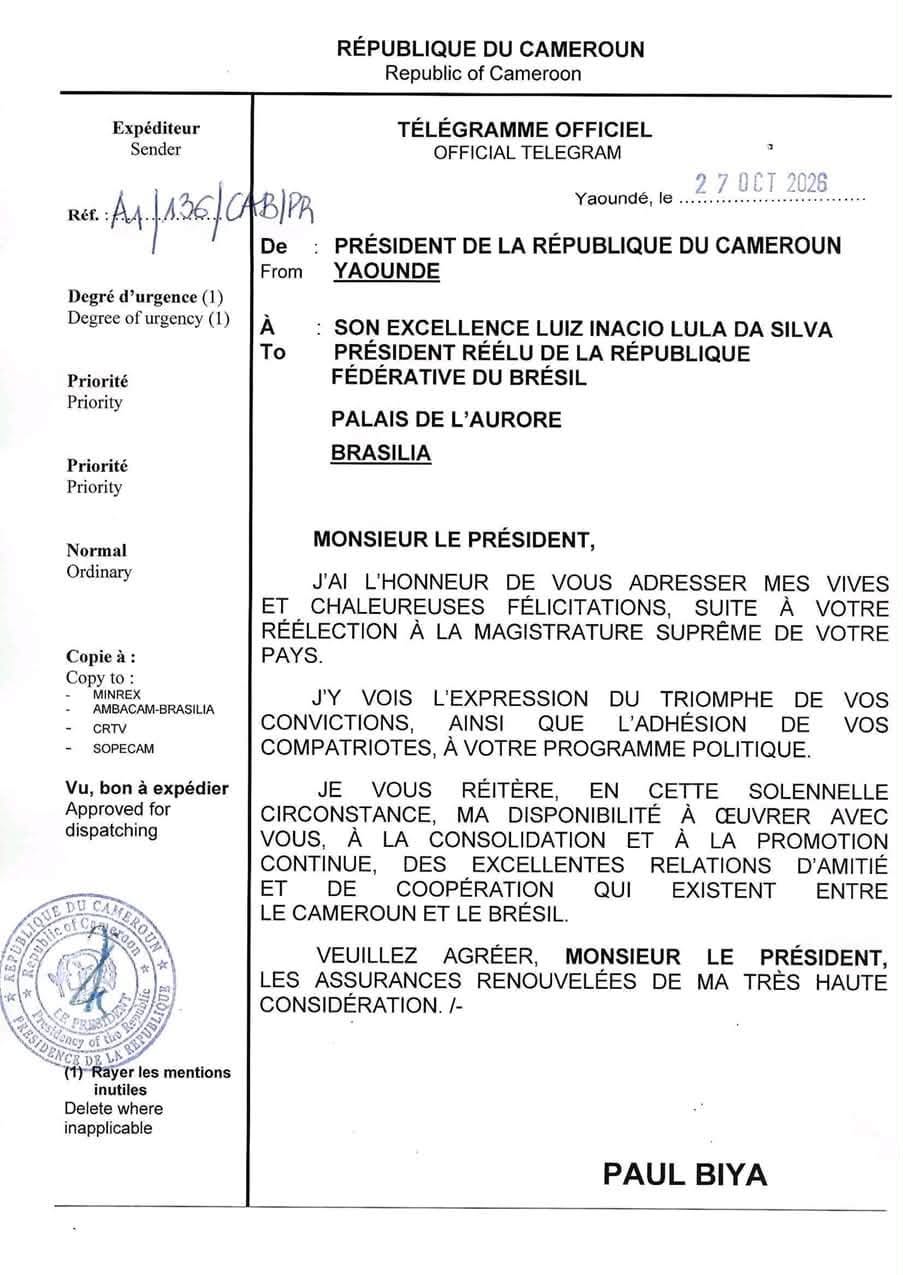
À la suite de la victoire électorale de Luiz Inácio Lula da Silva lors du second tour de l’élection présidentielle brésilienne d’octobre 2026, le président camerounais Paul Biya lui a adressé un télégramme officiel de félicitations. Ce geste protocolaire met en lumière l’amitié de longue date entre les deux hommes et souligne la dynamique d’une coopération bilatérale solide entre Yaoundé et Brasilia.
Le 27 octobre 2026, le président de la République du Cameroun, Paul Biya, a formellement adressé ses « vives et chaleureuses félicitations » à son homologue brésilien, Luiz Inácio Lula da Silva, pour sa réélection à la magistrature suprême de la République fédérative du Brésil.
Dans ce télégramme officiel, le chef de l’État camerounais y voit l’expression du « triomphe de vos convictions, ainsi que l’adhésion de vos compatriotes à votre programme politique », tout en réitérant son entière disponibilité à œuvrer au renforcement des relations bilatérales.
Une amitié politique ancrée dans l’histoire
Le lien qui unit Paul Biya et Lula da Silva ne date pas d’hier. Il s’enracine au cœur des années 2000, période durant laquelle la diplomatie entre les deux nations a connu son plus bel essor. En avril 2005, Lula da Silva marquait l’histoire en effectuant la toute première visite officielle d’un président brésilien au Cameroun, une occasion symbolique marquée par la réouverture de l’ambassade du Brésil à Yaoundé.
En réponse, le président Paul Biya s’était rendu à Brasilia en août 2010 pour consolider ces acquis. Les deux dirigeants partagent une vision commune du codéveloppement et de l’affirmation des nations du Sud sur la scène internationale.
La relation Cameroun-Brésil : un partenariat multidimensionnel
Au-delà de l’estime mutuelle entre les deux dirigeants, l’axe Yaoundé-Brasilia s’illustre par une coopération technique et stratégique diversifiée. Les accords bilatéraux couvrent de nombreux secteurs clés, notamment, la sécurité maritime et défense. La Marine brésilienne collabore activement avec les forces camerounaises, notamment à travers le transfert d’expertises et l’implémentation de systèmes intégrés de sécurité du trafic maritime dans le golfe de Guinée.
Des traités d’extradition et de transfèrement de personnes condamnées lient les deux capitales depuis 2019. Aussi, les échanges portent régulièrement sur le développement agricole, la pisciculture et le partage de technologies adaptées aux climats tropicaux.
Le message officiel envoyé depuis le Palais de l’Unité réaffirme l’importance de cette alliance transatlantique et ouvre la voie à de nouvelles perspectives économiques et diplomatiques pour les années à venir sous ce nouveau mandat de Lula.
Rejoindre notre chaîne télégram pour avoir les dernières infos
Cliquez ici
 Société2 years ago
Présidentielle 2025 au Cameroun: voici les 10 candidats qui ont déjà déclaré leurs candidatures
- Dernières actualités2 years ago
Cameroun : Liste complète des 250 ethnies qui font la fierté de la nation
- Politique2 years ago
Présidentielle 2025 : voici les 10 candidats qui ont déjà déclaré leurs candidatures
- Politique2 years ago
Élections présidentielles 2025 au Cameroun : Quels candidats ont les meilleures chances de succès ?
- Sports2 years ago
A. Song ⁚ >
- Actualités locales8 months ago
Théodore Datouo élu président de l’Assemblée nationale du Cameroun !
- Sports2 years ago
Cameroun ⁚ les clubs déjà sous pression
- Société2 years ago
Obtenez votre CNI en 48 heures : voici les 13 centres d’enrôlement au Cameroun