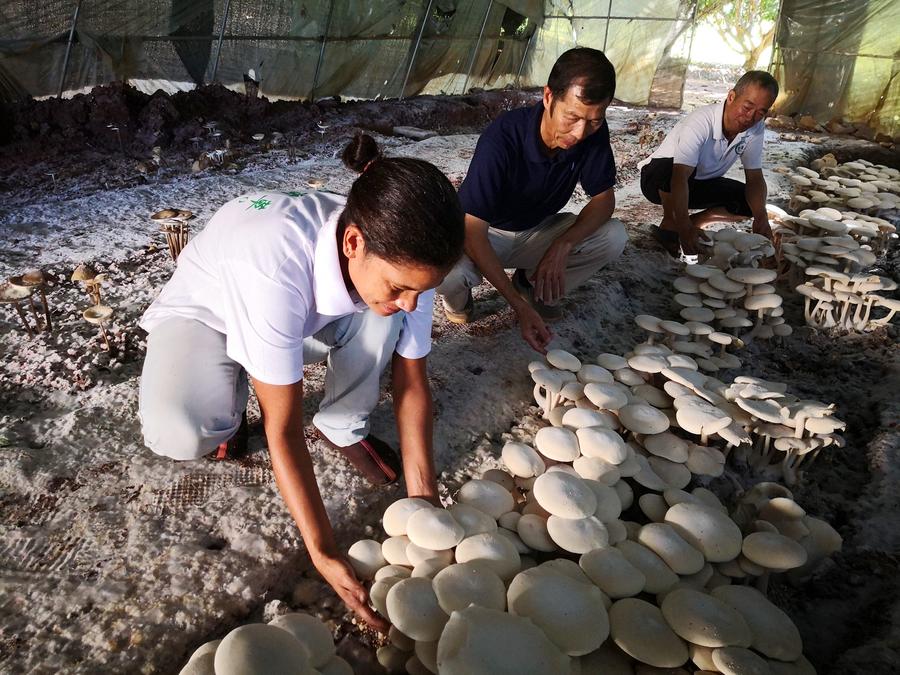
It was pleasantly warm and dry in Rwanda in early August, and young farmers in Southern Province were celebrating a bountiful harvest. Their hands were not bunched with corn or rice but with mushrooms, cultivated with the help of a technology transferred from a country far away to this « land of a thousand hills » in Africa.
Joining the celebration was Professor Lin Zhanxi. Since the 1980s, the octogenarian scientist has led a research team on Juncao technology in China’s southeastern Fujian Province. The hybrid grass technology enables fungi to grow on grass-based substrates instead of felled trees, a solution to the mushroom industry’s threat to forests.
The plant’s name means « mushroom » and « grass » in Chinese. Its versatility is a key feature, allowing it to grow edible mushrooms, provide livestock feed and help battle desertification.
Thanks to the active and visionary promotion by Chinese President Xi Jinping, Juncao is thriving in and beyond China, improving livelihoods and fostering sustainable development in developing nations across the Asia-Pacific, Africa and Latin America.
A WAY OUT OF POVERTY
Before known as « the father of Juncao, » Lin grew up in the impoverished rural mountains of Fujian. His personal experiences with poverty profoundly shaped his commitment to Juncao technology.
After decades of work, Lin and his team succeeded in selecting and breeding a type of high-yield, drought and salinity-resistant herbaceous plant that can be used as a substitute for wood to grow edible and medicinal mushrooms.
Lin Zhanxi, professor with the Fujian Agriculture and Forestry University (FAFU), presents the flourishing roots of Juncao in Fuzhou, capital of southeast China’s Fujian Province, Nov. 2, 2018. (Xinhua/Wei Peiquan)
At the ninth Aid-for-Trade Global Review Conference held by the WTO in Geneva in June, Lin reflected on how Juncao technology began its global journey. It was back in 1992 when Lin first presented Juncao to widespread acclaim at an international exhibition on inventions, also in Geneva. There in Switzerland, Lin received many calls to learn more about the technology.
Lin recalled how Xi has passionately supported using scientific and technological means to combat poverty.
In 1997, Xi, then deputy secretary of the Communist Party of China Fujian Provincial Committee, listed Juncao technology as part of the province’s poverty reduction efforts with the northwestern Ningxia Hui Autonomous Region. Upon receiving the assignment, Lin immediately took his team, as well as grass and fungus seeds, to Xihaigu, a poverty-stricken region in Ningxia.
Today, Juncao technology is used in 31 provinces across China and has significantly contributed to ending poverty and revitalizing rural areas.
With Xi’s support, a pilot project to introduce Juncao technology in Papua New Guinea was launched in 2000, becoming one of the first applications of Juncao technology overseas.
Lin Yingxing (C), specialist from the Fujian Agriculture and Forestry University, explains Juncao, which in Chinese literally means « mushroom » and « grass, » to local residents in the Eastern Highlands Province of Papua New Guinea, Dec. 19, 2019. (Photo by Hu Yingping/Xinhua)
Fuelled by their dedication and pioneering spirit, Lin and other Chinese researchers have since introduced the technology to 106 countries and regions across the globe.
With a mission to end poverty around the world, Chinese scientists have applied Juncao technology to some challenging environments. In Papua New Guinea’s Eastern Highlands, they witnessed tribes still practicing slash-and-burn agriculture. In Rwanda, families without access to cattle or tractors labored in muddy fields using only hoes. In the Central African Republic, they observed the devastating impact of post-conflict famine.
Throughout these years, Lin has faced gunpoint robberies, malaria, altitude sickness and long periods in remote outposts without electricity or water. Witnessing extreme poverty in developing countries further strengthened Lin’s commitment to Juncao.
« We go to the poorest places with a genuine intent to help the people, » Lin stated.
Villagers wait to be served with freshly fried mushrooms in Gba village of Bangui, the Central African Republic, Feb. 5, 2024. (Xinhua/Han Xu)
A PLANT OF PROSPERITY
Agnes Ayinkamiye is the first coordinator of the Juncao project in Rwanda.
« One of the things that made me especially happy was how we helped people. The project was well-received, and we trained many people, particularly women’s cooperatives and youth groups, » she said. « I enjoyed my work immensely and was thrilled to collaborate with experts. »
« People can earn money through Juncao technology, and it’s become quite popular, » Ayinkamiye added.
Lin noted that around 4,000 Rwandan households have benefited from the technology, with some experiencing their incomes double or even triple over the years.
« Juncao technology is affordable … This technology is applied in such a way that makes it affordable for people at a very local level, which I believe is the key benefit, » said Earle Courtenay Rattray, chef de cabinet to the United Nations Secretary-General.
Seruwaia Kabukabu, an entrepreneur in Serea Village of Fiji’s Naitasiri Province, is one of the women trained at the Juncao demonstration center in Nadi, Fiji’s third-largest city.
« After the training, every one of us received mushroom substrate bags for free from the center. Under the guidance of technical experts, we began to harvest and sell mushrooms within 7-10 days, earning money for our family, » Kabukabu said.
The income from the Juncao project allowed her to improve her family’s living standards by purchasing essential appliances, building a concrete toilet and bathroom, and even contributing to a clean water project in her community.
« Fiji faces numerous problems ranging from geographical isolation, susceptibility to natural disasters due to climate change that hinders agricultural, and sustainable development and food security, » Kabukabu said.
Over the past decade, over 2,400 people in Fiji have received training on Juncao technology, with the Juncao cultivation area in Fiji exceeding 2,000 hectares.
« Simple to learn and effective to implement, » said Lin, emphasizing that Juncao technology should lower its technical application threshold abroad « so that even the poorest farmers can get involved. »
To date, nearly 350 international workshops have trained over 14,000 people in Juncao technology, with introductory papers now available in 18 languages for global use.
Students from Rwanda and Papua New Guinea check the growth of Juncao at Fujian Agriculture and Forestry University in Fuzhou, southeast China’s Fujian Province, March 28, 2024. (Xinhua/Lin Shanchuan) Having taken root in over 100 countries and regions around the globe, Juncao has been hailed by the locals as the « Chinese grass » or « grass of happiness. » (Xinhua/Lin Shanchuan)
NEVER-ENDING EXPERIMENT
Apart from cultivating mushrooms, Juncao technology has continued to innovate, expanding its production to include feed and fertilizer.
Since using Juncao as fodder, Tahiya Massawe, a farmer in Bumbwi Sudi, Tanzania, has observed improved milk density and nutrition and increased milk production.
« It has also saved money for me, » she told Xinhua, « because the budget I previously spent on other feed is now saved by using this grass. »
Farmers multiply Juncao and use it on their farms. Many testimonials show that farmers have accepted the technology simply because the feeds are rich, said Makame Kitwana, director of Planning, Policy and Research at Tanzania’s agriculture ministry.
« In a number of ways, scientifically, it has (been proven) that the protein content, as well as carbon content, is high, making cattle more satisfied when consuming Juncao grass compared to other grasses, » he said.
A Chinese expert instructs local staff members to plant Juncao seedlings at the animal husbandry technology demonstration center in Mauritania, May 27, 2024. (Xinhua)
Juncao can also help with ecological management.
Soil erosion has been a serious problem in countries such as Rwanda. Rwandan officials used to worry that if the soil problem could not be resolved, Rwanda would have no land to cultivate. Lin always kept their concerns in mind.
He still remembers the experimental data in Rwanda during his visit over a decade ago. On one day the rainfall for two and a half hours reached 51.4 millimeters. All the rain was captured by the giant (Juncao) grass, and it was very effective in water conservation and soil retention.
In February in Fiji, Lin also worked on applying Juncao technology to saline soil management, aiming to seek additional solutions to combat climate change for developing countries, including Pacific island nations.
« The experimental results were very promising, » Lin said. « Juncao is the grass of happiness, a gift from China to all. »
À un an du scrutin présidentiel prévu le 12 octobre 2025, la machine du Rassemblement démocratique du peuple camerounais (RDPC) se met en branle dans le département du Moungo. Lejeune Mbella Mbella, ministre des Relations extérieures et chef de la délégation permanente départementale du Comité central, a mené une vaste caravane politique à travers plusieurs arrondissements. Objectif affiché : préparer le terrain pour une victoire éclatante de Paul Biya.
Une caravane pour remobiliser la base du RDPC
Melong, Baré-Bakem, Nkongsamba I, II et III… La tournée de Lejeune Mbella Mbella s’est poursuivie ce week-end dans les grandes localités du Moungo. Partout, la même mission : rallier et galvaniser les militants autour de la candidature de Paul Biya à la présidentielle 2025.
Le ministre ne s’est pas déplacé seul. À ses côtés, plusieurs cadres du parti : le sénateur Siegfried Étamé Massoma, Patrice Essobmadje, chargé de mission, ainsi que Mpoudi Ngolle Evelyne. Tous mobilisés derrière le même mot d’ordre : unité, discipline et fidélité au « candidat naturel ».
Recommandations ciblées et défis électoraux
Après avoir écouté les différents responsables des organes de base du RDPC, Mbella Mbella a délivré des recommandations adaptées à chaque arrondissement, insistant sur l’importance de tenir compte des réalités locales. Le mot d’ordre est clair : renforcer les structures, apaiser les tensions internes et surtout… reconquérir les bastions perdus.
Car le défi majeur reste bien identifié : reprendre les communes de Njombé-Penja et Loum, passées sous le contrôle de l’opposition. Une priorité stratégique pour assurer une victoire sans appel en octobre 2025.
« Taire les divisions » pour la victoire de Paul Biya
Devant les militants, le chef de la délégation permanente départementale a exhorté ses troupes à rester soudées : « L’heure n’est pas aux querelles intestines. Nous devons taire nos divisions pour aller vers la victoire de Paul Biya », a martelé Mbella Mbella, reprenant un message d’unité déjà répété lors des étapes précédentes.
Dans une atmosphère parfois festive, parfois solennelle, le RDPC a affiché sa détermination. Paul Biya, candidat annoncé pour un nouveau mandat, reste plus que jamais la figure tutélaire autour de laquelle s’organise toute la stratégie du Moungo.
Le président de la République, Paul Biya, a reçu ce vendredi 29 août 2025 en audience d’adieu l’ambassadeur de France sortant au Cameroun,Thierry Marchand.
Une rencontre d’adieu empreinte de cordialité
Durant plus d’une heure et demie, l’entretien a permis au diplomate français de saluer le chef de l’État camerounais et de revenir sur ses trois années passées à Yaoundé. Thierry Marchand a tenu à exprimer toute sa reconnaissance pour « l’hospitalité légendaire du Cameroun », qui l’a profondément marqué tout au long de sa mission diplomatique.
Un partenariat historique entre le Cameroun et la France
Au sortir de l’audience, l’ambassadeur a rappelé la solidité des liens qui unissent les deux pays. « Le Cameroun et la France sont des partenaires de longue date », a-t-il souligné, tout en saluant les efforts continus des dirigeants des deux nations pour renforcer une coopération bilatérale jugée mutuellement bénéfique.
Trois années de coopération renforcée
Nommé en 2022, Thierry Marchand aura accompagné plusieurs chantiers stratégiques de la relation franco-camerounaise, notamment sur les plans économique, culturel et sécuritaire. Son départ marque la fin d’une étape importante, mais les deux capitales entendent maintenir le cap d’un partenariat solide.